Sunday, May 22, 2011
The Flute Player
When I walk the dog at 7:15 in the morning, there is a man and an woman who circumnavigate the park the opposite direction from me and Sandy. He plays some simple wooden flute while she simply walks. I'll try to get a picture

Wednesday, November 18, 2009
Ronald McDonald in Japan
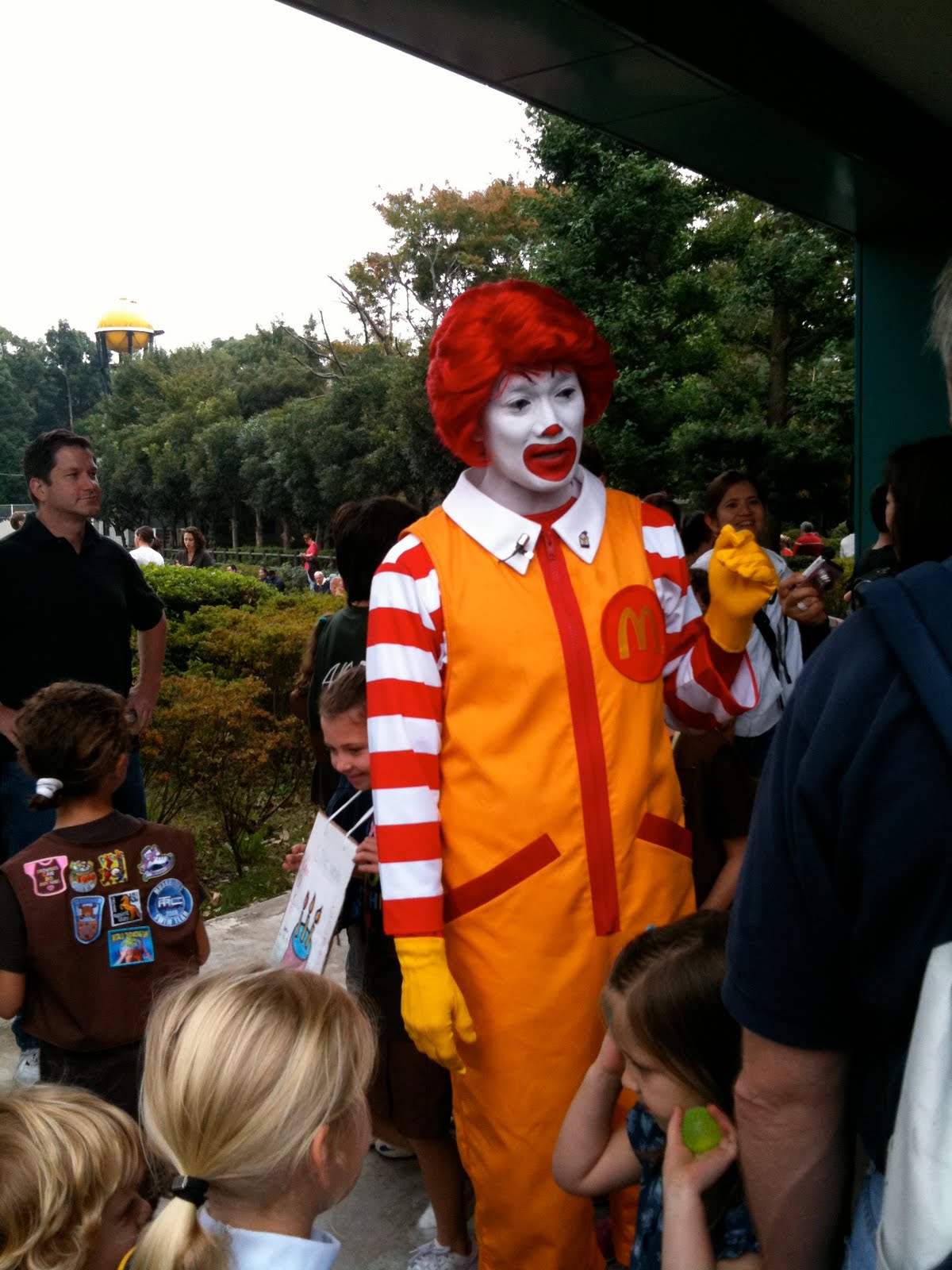
Since somebody asked: the Quarter Pounder is the クオ一タ一パウンダ一 , of course. You would pronounce that kuo ta pa oon da. Add the cheese, its a クオ一タ一パウンダ一テ一ズ (chi zu)
Monday, November 16, 2009
Difference

After I buy my bleach and deodorizer, I take them to the counter to pay for them. The nice sales person wraps them both in plastic before putting them in a plastic shopping bag.
Wednesday, November 4, 2009
Urban Planning
Driving in Tokyo can be a interesting thing. Nevermind fact that they drive on the right hand side and that streets are rarely labeled.
This post is about the size of the streets.
I'd estimate that about 80% of the roads in Tokyo are fairly narrow one-lane streets that are intended for two way traffic, pedestrians and bicyclist. The telephone poles also are in the streets, albeit at the edge. Sandy--on the leash here--helps provide scale for this picture.

The major arteries are wide and accomodate a lot of traffic. Still, such roads are also used by many bicyclists and motorpeds that dart between cars, so one has to be a particularly attentive driver. On such roads, pedestian crossings are carefully managaged. Fencing inhibits jaywalking (which is discouraged and not much practiced here). Between corner crossings, there are many raised pedestrian crossways. This picture was taken from one such elevated pedestrian bridge.

These pictures were taken on an early Sunday morning without much traffic, but will give you an idea of the scale of the roads.
All and all, I would have to say that this helps to discourage driving and concentrate vehicular traffic to the major roadways. It also encourages the use of public transportation or self-transportation.
I will have to say I love riding my bike to the grocery store.
This post is about the size of the streets.
I'd estimate that about 80% of the roads in Tokyo are fairly narrow one-lane streets that are intended for two way traffic, pedestrians and bicyclist. The telephone poles also are in the streets, albeit at the edge. Sandy--on the leash here--helps provide scale for this picture.

The major arteries are wide and accomodate a lot of traffic. Still, such roads are also used by many bicyclists and motorpeds that dart between cars, so one has to be a particularly attentive driver. On such roads, pedestian crossings are carefully managaged. Fencing inhibits jaywalking (which is discouraged and not much practiced here). Between corner crossings, there are many raised pedestrian crossways. This picture was taken from one such elevated pedestrian bridge.

These pictures were taken on an early Sunday morning without much traffic, but will give you an idea of the scale of the roads.
All and all, I would have to say that this helps to discourage driving and concentrate vehicular traffic to the major roadways. It also encourages the use of public transportation or self-transportation.
I will have to say I love riding my bike to the grocery store.
Monday, November 2, 2009
Yoyogi Park

This morning, Sandy Peach woke me up pretty early in the morning for a walk. She and I were out in Yoyogi Park by 5;15 am, before the sun came up. As we walked to one of the quieter corners of the park, I observed some strange motion underneath a dense cluster of tress. As I got nearer, I realized it was a man repeatedly practicing karate kicks.
Public space is extremely well used in Japan. Yoyogi Park, is one of the largest Parks in Tokyo (see picture at the bottom of this blog). It is always full of human activity. On weekends cars line the street near our apartment waiting for a parking space. Families spread out plastic sheets and settle in for long picnics.
The night Sandy Peach arrived (6 hours late--a typhoon delayed her flight) I took her for a long walk in Yoyogi Park at midnight. I am rarely up that late so it was my first encounter with the park late at night. I discovered that midnight is a popular time to jog here in Tokyo.
Anyway, I have started a new list in the right hand bar of this blog--a list of things I have seen people doing in Yoyogi park. I'll update as I note new and unique things that people do in Yoyogi Park.
Wednesday, October 28, 2009
Nara River Walk


It was supposed to be a lovely walk by the Nara river north of Hachioji with our recently arrived dog. Unfortunately, the 20 year old book, "Day Walks Near Tokyo" missed 20 years of changing river patterns and human habits. The path we were supposed to find petered out amidst thick growth rife with thorny plants and large spider webs.
Not all was lost. Sandy didn't mind the thorns a bit, and we found a nice rock outcrop near the river to enjoy our bento boxes. While sitting there, we could watch all the people who were--20 years after the book was published--making paths on the other side of the river for their picnics and fishing.
Finding a ice cream shop on the way home put a sweet spin on the whole outing.
Green in small spaces
While there is lots of concrete around, what I have discovered is that the Japanese bring nature to life in small spaces. Here are just a few examples of green space created around people's entryways, usually using potted plants.


Friday, October 9, 2009
The 5 of Japanese cooking

A japanese meal is supposed to exemplify these fives:
* Goshiki (five colors): aka(red); kiiro (yellow); ao (green); kuro (black); shiro (white).
* Goho (five methods): niru (simmer); musu (steam); yaku (grill); ageru (fry); tsukuru (create).
* Gomi (five flavors): shiokarai (salty); suppai (sour); amai (sweet); Nigai (bitter); karai (spicy).
* Gokan (five senses): miru (sight); kiku (hearing); kaku (smell); ajiwau (taste); fureru (touch).
A bit overwhelming to contemplate as a cook, but there is more::
* Gokan no mon — the five viewpoints or outlooks — a Buddhist doctrine referring to the state of mind to be maintained while partaking of the food. The first tenet is to ponder deep gratitude for the people who prepared the meal. Second is to perform deeds and have thoughts worthy of receiving such nourishment. Third is to partake of the food with no ire. Fourth is to realize that eating this food is feeding the soul as well as the body. And finally, the fifth consideration is to be seriously engaged on the road to enlightenment.
A little Japanese food for thought.
See this article from the Japan Times for more info
Tuesday, September 29, 2009
Difference
In that spirit, our lives here are full of such differences, from small to large, so I anticipate a bunch of posts which simply show difference.

 if these peaches look big, they are. Peaches tend to run about 25 to 50% bigger over here.
Such as how red peppers and lemons are usually wrapped at the grocery store:

or the styrofoam netting that cushions delicate fruit:
if these peaches look big, they are. Peaches tend to run about 25 to 50% bigger over here.Thursday, September 24, 2009
Presiding Bishop of ECUSA visits Tokyo
A talk by the Right Reverend Bishop Katherine Jefferts Schori in Tokyo on September 23rd, 2009: From Right to left, Rev. Iijima, the president of the National Christian Coucil of Japan, Rev. Koshi-ishi, moderator of the National Christian Counsel of Japan, The Right Reverend Katherine Jefferts Schori,Presiding Bishop of ECUSA, a woman whose name I did not catch, and Peter Ng, partnership officer for Asia and the Pacific in the Episcopal Church's Office of Anglican and Global Relations (AGR)
From Right to left, Rev. Iijima, the president of the National Christian Coucil of Japan, Rev. Koshi-ishi, moderator of the National Christian Counsel of Japan, The Right Reverend Katherine Jefferts Schori,Presiding Bishop of ECUSA, a woman whose name I did not catch, and Peter Ng, partnership officer for Asia and the Pacific in the Episcopal Church's Office of Anglican and Global Relations (AGR)Rt. Rev. Schori participated in the celebration of the 150th Anniversary of the Anglican Church in Japan (Nippon Sei Ko Kai).
To me, most interesting was the questions that the Japanese church brought to one represents the church in America: questions about peace making in Asia and the Middle East, the role of the church as advocate for such issues in US policy, and the presence of the US military in Japan.
A dish lover's find
There are many amazing things to find along the "kitchen" street, Kappabashi Dori. This last time there we discovered a store that smelled like my grandmother's attic, and was packed floor to ceiling with china and pottery. Greg nicknamed it the "Crazy Man's China Emporium," cause you almost had to be crazy to get through the aisles and it was certainly packed with China. Listen for the sound of my foot hitting a pile of dishes in this clip.
We bought some bowls and plates.
Monday, September 21, 2009
Amazon

Setting up my Amazon.jp account today.
The books are more expensive. Richard Russo's "Bridge of Sighs?" $10.17 on Amazon, ¥2616 ($28) on Amazon.jp. Still, its cheaper than sending stuff from the US.
You can buy alcohol at the Amazon.jp.
Once you get out of the English language books on Amazon.jp, they really don't expect to serve the english speaking community. But its fun to click around anyway.
Friday, September 18, 2009
Italian food

Yesterday I went to a PTA coffee where I two women who invited me to join them for lunch. Rita is Italian. She has moved every 2 years in her adult life, and has lived in Paris, Rome, Milan, New Jersey among other places. Mariko was raised in Kyoto and sent to California as a teenager to go to an American boarding school. She married a Navy officer who is working at the embassy. They have lived in Japan twice and a number of years in Fairfax county Virginia. Clearly, the three of us have a lot of moves between us.
Rita suggested an Italian restaurant. Once there, Rita carefully surveyed the menu and then suggested what we should order. We started with a sampler of Mozzarella--three kinds. It was about he freshest mozzarella I've had outside of the North End of Boston. Yummy.
Still, something amusing about the fact Rita told Mariko what to order, so she could translate it to Japanese for the waiter. The wait staff would deliver the meal and tell us, in Japanese, how to eat the food that is Rita's native fare.
Mariko said she would take us to a traditional Japanese restaurant for lunch next time. I offered to do my part too: MacDonald's and then follow up with a Starbucks.
Plantings
I don't think I've ever seen this extremely purple plant before. The other thing to note here is how even tiny spaces are used for plantings. This is a very narrow walkway next to a train track. 

Thursday, September 17, 2009
Making Church Connections

Yesterday I visited the "God box" of Japan (reference is the building in New York City that has housed church and church related organizations, nicknamed the God box). Our UCC missionary, Jeffrey Mensendiek, was kind enough to meet me in Tokyo and take me to lunch and then to the National Christian Council in Japan (NCCJ).
The most charming thing is how church related offices look the same here. Namely, there stacks of paper everywhere. Boxes of paper, stacks of newsletters, piles of paper. It warmed my heart and made me feel quite at home.
One of the concerns of the NCCJ is Article 9 of the Japanese Peace Constitution. See this document. You may be hearing more about this.
Tuesday, September 8, 2009
Learning the Alphabets

So the first thing to notice is that I said alphabets. Plural. There are 4 that are used. Kanji--those characters borrowed from the Chinese (most of them have two possible readings--I won't go into that now). Then there is the Hiragana, the letters used to represent Japanese syllables. Next, the Katakana, a another syllabary system that the Japanese use to represent words borrowed from other languages. Then there are the occasional uses of Latin Alphabet and numerals. Writing in Japanese uses all four of these mixed together.
(This borrowed from Wikipedia:) Here is an example of a newspaper headline (from the Asahi Shimbun on 19 April 2004) that uses all four scripts: (kanji (red), hiragana (blue), katakana (green), and Latin Alphabet and Arabic numerals (black)):
- ラドクリフ、マラソン五輪代表に1万m出場にも含み
Finally, there is the Romaji--that is japanese words written with Roman characters. Its transliteration, in effect. At least I don't have to learn this alphabet. But the Japanese don't tend to use Romaji for anything of import. You really only find it in the guidebooks or texts that are trying to teach English speakers how to speak Japanese.
Andrew's Japanese teacher mentioned that you have to learn 94 new characters to master Hiragana and Katakana. That is my goal. That is what they will teach Andrew by January this year.
The average high school graduate would know about 2000 Kanji. I'll be happy if I learn about 50.
Wish us luck!
Wednesday, September 2, 2009


Tuesday, September 1, 2009
Trees

Compared to East Coast US cities, Tokyo is not very tree-d. In fact, it is a concrete jungle. But every now and then you happen upon small spaces that are beautifully landscaped. This one is just off the famous and congested teen shopping street, Harajuku. It is next to the Admiral Tōgō Heihachiro shrine, also a beautiful place.
Monday, August 31, 2009

Saturday, August 29, 2009
It really is true...
 ....sushi in Japan really is a noticeably different thing. It looks the same. But it just tastes fresher. What you are supposed to order is not your 5 favorites, but the specials--fresh seafood. Unfortunately for us, listed in Japanese, but we did get two "specials" eel and something called sourel. Even the shaved ginger is more tender.
Subscribe to:
Posts (Atom)

 Posts
Posts


